Why Does Google Hate Small Bloggers? (And Other Anxieties)
Feel like you're writing into the void? You're not alone. We tackle the paralyzing fear that the game is rigged, debunk the myths, and show you how to actually get seen by the right people, even when you're just starting out.

A guide for creators who are tired of writing content that disappears into the void.
You've been there.
You spend hours on an article, crafting something you know is valuable. You hit publish… and then… nothing. Crickets. Zero views. Maybe one from your own phone, checking if it published correctly.
It feels personal, like your expertise is meaningless if nobody knows you exist. And it's enough to make you ask the question: Is the whole game rigged? Does Google just HATE small bloggers?
Here's the truth: You're not crazy. The game does feel rigged, because most small creators are playing by the wrong rules. They're trying to compete with big brands, using the same tactics, without any of the resources.
But here's the good news: your biggest anxieties—the ones keeping you up at 2am wondering if this is all pointless – are actually the key to a completely different, and better, way to build an audience.
Let's talk about what's really going on.
"Am I Just Wasting My Time?" A Guide to Creator Anxiety
Let's start by naming the thing nobody wants to admit: the anxiety isn't really about Google's algorithm. It's about you. About whether this whole content thing is a massive waste of time. About whether you're just shouting into a void that will never shout back.
There are three flavors of this anxiety, and if you've been creating content for more than a few months, you've tasted them all.

Anxiety #1: The "Paralyzing Self-Doubt"
It's not just about Google. It's that paralyzing feeling that marketing is a "mystical black art" you'll never understand—that there's some secret handshake, some insider knowledge, that everyone else has access to except you.
For many small business owners and solopreneurs, this anxiety becomes existential. You built something real. You have actual expertise. But if you can't market it, if you can't get found, then what's the point?
This fear is what leads to endless research. You buy another course. You read another blog post about SEO tips for bloggers. You watch another YouTube video promising "the secret." Because it feels safer to learn about small business SEO than to do the scary work of publishing something that might fail publicly.
But here's the brutal truth nobody wants to hear:
The Expert Trap
Asking experts "will this work?" is often just another form of hiding.
There's an old entrepreneurial wisdom: "It's better to do something once than to ask ten times." The desire for a ready-made answer – the perfect content marketing strategy handed to you on a silver platter – stems from one of two places. Either you're unwilling to do the work, or you're afraid of making a mistake. Both are fundamentally incompatible with actually building something people want.
You won't find the truth from experts. You'll find it from your customers. From your readers. From the people who either show up or don't, who either engage or scroll past.
Testing with real people may yield unexpected answers – and that's the entire point. Everything obvious has already been tried and done.
Anxiety #2: The "Three Years of Wasted Effort"
This one cuts deeper.
You didn't skip the research phase. You did what the tools told you to do. You installed the plugins. You got the "perfect scores" on your posts. You followed the checklist. Green lights all the way down.
The result? Invisible content.
This is the frustration of what we might call the "Pragmatic Site Manager" – someone who trusted the system, who played by the rules, and got absolutely nothing in return. It creates a deep-seated distrust of bloated software that gives you a false sense of accomplishment. All those green checkmarks, all those "SEO-optimized" badges, and still... crickets.
But here's something most creators don't want to hear:
The 5-Minute Truth
If your content doesn't get traction in the first few days, no amount of "improvements" will fix it.
I know a successful entrepreneur who discovered he can predict the total engagement of any post just from its first 5 minutes of performance. Seems impossible, right? But the pattern holds. If something doesn't catch immediately, it rarely catches at all.
The same principle applies to your niche SEO strategy. If your approach isn't working after several genuine attempts with real validation – not vanity metrics, but actual connections with actual humans – then you don't need to "grit your teeth and improve." You need to grit your teeth and try something completely different.
The good news? You don't have to wait months to know. The market tells you fast. You just have to be willing to listen.
Anxiety #3: The "Meltdown" of Complexity
You just want to run your business.
You didn't sign up to become an SEO expert. You didn't plan on spending hours wrestling with technical configurations and best SEO tools for bloggers. But somewhere along the way, you got forced into this role, leading to what can only be described as a full-blown meltdown with increasingly complex tools that promise everything and deliver confusion.
This anxiety is often made worse by new fears, with many creators also afraid that AI will make their blog obsolete.
You're not afraid of work. You're afraid of wasted work.
You just want something to look at your finished article and tell you, honestly, why no one is finding it. You want transparency. You want simplicity. You want to get back to the thing you're actually good at.
But there's a trap here too:
The Overachiever Syndrome
There's a dangerous belief floating around that any problem can be solved by "finding the right textbook" and learning harder. By grinding more. By enduring.
Here's a story that might change your mind: A 15-year-old startup founder built a career guidance platform for students. She got some sales. She even raised a small investment. But it wasn't selling well. And when she asked for advice, the response was brutally honest: "This is a product for smart, motivated people, who are a minority even among adults. You should look for another direction."
Her response? "Okay, we will consider new directions. We're not discouraged – we move forward."
No overachiever syndrome. No "but if I just improve it more..." No clinging to a strategy that wasn't working. Just pragmatic action.
That's the mindset shift that matters. Not learning more about SEO for solopreneurs. But learning when to pivot.
How to Compete When You're Not a Mega-Brand
Okay, so we've named the anxiety. Now let's talk about why the current approach isn't working – and what actually does.
The fundamental problem is this: most small bloggers are trying to compete using the playbook designed for enterprise brands with six-figure marketing budgets. You're playing their game, on their turf, with none of their resources.
That's not a strategy. That's a suicide mission.
Stop Competing on "Big" Keywords
The giants will always win on broad topics. Always. That's their game, and they're playing with loaded dice – established domain authority, massive content teams, endless budgets for link building.
Trying to rank for "best running shoes" or "content marketing" or any of the massive, obvious keywords is exactly why you feel invisible. You're playing on their turf. And this is the 'old way' of doing small business SEO – throwing yourself against walls that were specifically built to keep you out.
It's a place where creativity goes to die. Where your budget evaporates. Where you work for months and have absolutely nothing to show for it.
But here's where it gets interesting:
The 33 Victories Strategy

Here's a powerful truth about competition: targeting long-tail keywords isn't just a strategy for small players – it's a necessity for survival in today's digital landscape.
A staggering 91.8% of all search queries are long-tail keywords, highlighting the vast opportunity they present. By focusing on these specific, less competitive phrases, you attract highly targeted traffic that's far more likely to convert.
This approach lets you sidestep the giants dominating broad terms and establish authority within your niche. Think of it like a tournament: if every human on Earth competed one-on-one, the champion would only need to win 33 times. Not 8 billion wins. Just 33 strategic victories.
Your strategy isn't to defeat Google on "running shoes." It's to choose and defeat the strongest among the weak at each stage. Target the micro-markets. The specific niches. The longtail queries where people are actually desperate for an answer.
In just a few steps, you can become the leader of an entire micro-market – the go-to resource for a specific type of person with a specific problem.
This is infinitely better than facing a massive competitor in the first round and losing immediately. This is niche SEO. This is how small players win.
Your "Unfair" Advantage: You're Not a Bland Corporation
Here's what you have that they don't:
Opinions. Specific expertise. The ability to talk directly to a human like an actual human.
Big brands have to stay neutral. They have to play it safe. They have to speak in the corporate voice that offends no one and inspires no one.
You don't.
The goal isn't to "guess" at what might work. It's to stop guessing entirely and start knowing what your specific audience is looking for. Not 900 visitors with zero sales. But one right person who has a problem you can actually solve.
That's the reframe. That's the mindset shift that changes everything.
Find the "Buyers, Not Browsers"
Stop looking for what's popular. Start looking for what's profitable.
You don't need another tool that "just spits out popular keywords." You have enough data. You have enough lists. What you need is a way to find the exact phrases someone types in when they are actively trying to solve a problem and are willing to pay for a solution.
These are the high-intent queries. The "cracks in the armor" of the big players. Because they're too big, too general, too brand-safe to focus on these specific, messy, human problems that your ideal customer is desperately trying to solve at 11pm on a Tuesday.
But here's the part that most SEO tips for bloggers miss entirely:
The Real Competition
You're not competing with other bloggers for Google's attention.
You're competing with every other way your ideal reader could spend their time right now. Netflix. TikTok. The group chat that just lit up. The email inbox that's calling their name.
Most content gets ignored not because it's bad, but because the reader doesn't feel they'll lose anything by scrolling past it. If your content is "useful" or "interesting" but not "necessary," it becomes optional. And optional always loses to easier alternatives.
This is why targeting "buyers, not browsers" matters. When someone is actively trying to solve a painful problem – when they're in crisis mode, when they're at their wit's end – your content isn't competing with cat videos. It's the answer they're desperately searching for.
That changes everything.
A Simple Path to "Quiet Confidence"
Alright. We've talked about the anxiety. We've talked about why the old approach doesn't work. Now let's talk about what actually does – and how to build a content marketing strategy that doesn't make you want to throw your laptop out the window.
From "Existential Threat" to "Boring, Manageable Chore"
The only way to beat anxiety is with a simple, repeatable process.
What if SEO wasn't a "creative challenge" that required genius-level insights every single time? What if it was just a boring, manageable chore you did at the end – like spell-checking, but for discoverability?
Here's the workflow:
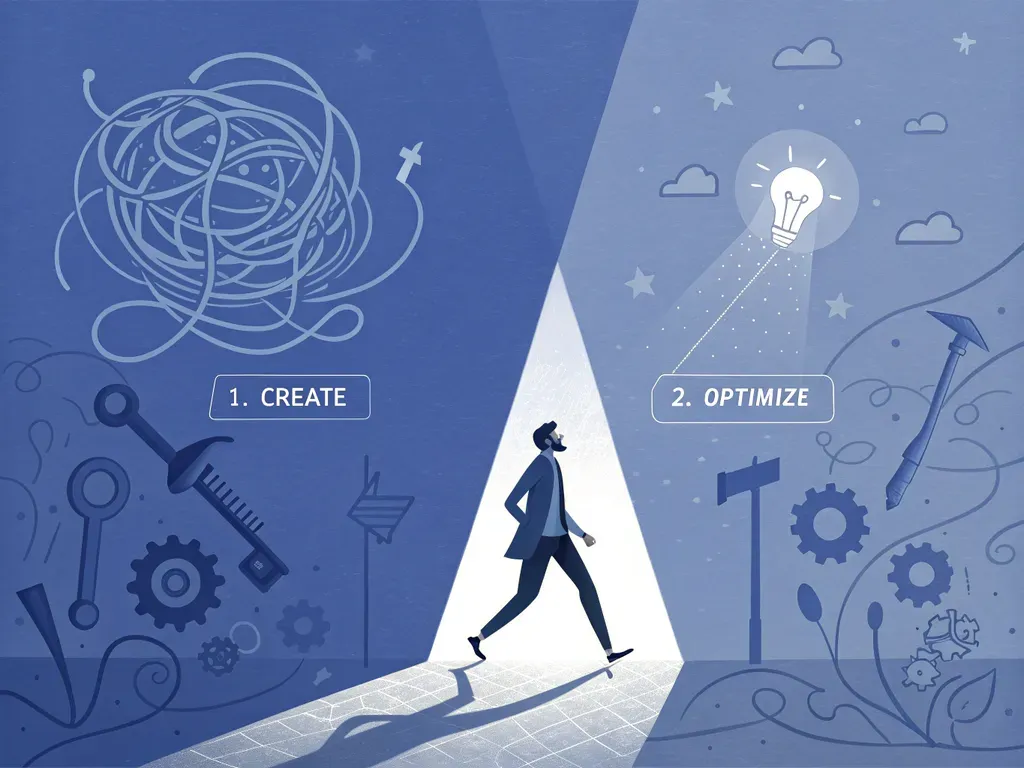
The answer is a 'Text-First' SEO workflow: Write your article first. Pour your expertise onto the page. Be human. Be specific. Be opinionated. Don't think about keywords. Don't optimize while you create. Just write the damn thing.
Then, use a simple tool to bridge the gap between the content you're already creating and the people who would actually benefit from reading it.
That's it. That's the process. Create first, optimize second.
But here's where most people get stuck:
Redefining "Launch"
Most creators think the launch happens when they hit "publish." The confetti moment. The "it's live!" announcement.
Wrong.
The real launch is when you get your first 10 customers. Your first 10 readers who actually engage. Your first 10 qualified leads who took a specific action because of what you wrote.
Once you count it this way, everything changes. You'll realize: "To get the first 10 customers, I don't need to launch all of this. I don't need the perfect website. I don't need 50 blog posts. It's enough to just do this."
That's your minimum viable content strategy. That's your actual starting point.
And here's the liberating part: You'll know if it's working within days, not months. You don't have to wait. You don't have to wonder. The market tells you immediately.
The Metric That Matters More Than Views
Here's a hard truth: You need to stop separating your self-worth from your view count.
Views are a vanity metric. They're a number that makes you feel good or terrible, but tells you almost nothing about whether your content actually worked.
The small win that actually matters: Did you connect with one person? Did one reader email you? Did you get one qualified lead? Did someone share it with a specific person saying "you need to read this"?
That's the only metric that builds "quiet confidence" and proves you're on the right track, even when the analytics dashboard is stuck at zero.
But there's a trap here too:
The Self-Deception Trap
It's easiest for any person to deceive themselves.
You'll convince yourself that "a few more tweaks" will make the difference. You'll ignore the signals that something fundamentally isn't working. You'll chase green checkmarks and perfect scores while your content disappears into the void.
Here's a thought experiment to break through the self-deception:
Imagine a specific person you know – someone with money, someone smart, but someone completely outside your field. Now pitch them your content strategy. Out loud. Like you're actually sitting across from them at a coffee shop.
What wouldn't they understand? What would they never believe? What questions would they ask that you can't answer honestly?
The further they are from your target market, the more critical points you'll discover. And that's the point. Use that clarity to fix what's actually broken, not what feels comfortable to fix.
The "Competition Clarity" Check
Before you spend another hour on small business SEO, before you buy another course on the best SEO tools for bloggers, stop and answer these three questions honestly:
1. The No-Competitor Question
"If there are no big competitors in my niche, why?"
If everyone playing in your space is small, one of two things is true: Either there's no money here, or you're missing the real (indirect) competitor. Figure out which. Because if it's the former, you're wasting your time. If it's the latter, you're about to get blindsided.
2. The Comparison Mistake
Don't confuse similar products in other markets (analogs) with actual competitors you need to beat.
Who are you actually trying to defeat? On what basis? What makes you genuinely different, not just "we care more" or "we're more authentic" – but functionally, strategically different?
If you can't answer this clearly, neither can your content.
3. The "Doing Nothing" Competitor
What's the worst that happens if someone doesn't read your content?
Will they suffer? Lose money? Miss an opportunity? Feel left out? Fall behind their competitors?
If the honest answer is "nothing bad happens," then you don't have a value proposition. You have a hobby. And hobbies don't build businesses.
You're Not Invisible, You're Just Un-Targeted

Google doesn't hate you.
It just doesn't know who you're for. Because you haven't told it clearly enough. Because you've been trying to be everything to everyone instead of being impossible to ignore by someone.
Your anxiety – the 2am wondering if this is all pointless, the fear that you're wasting your time, the frustration of doing everything "right" and still getting nothing – that anxiety is actually a sign that you care. It's a powerful asset. It means you're trying to create something of genuine value.
The solution isn't "more SEO." It's less, but better.
It's about having the confidence to publish, knowing you've given your article the best possible chance to be discovered by the right people. Not all the people. Just the ones who are actively looking for exactly what you have to offer.
The final reframe: Stop trying to be found by everyone. Start being impossible to ignore by someone.
That's how small bloggers win.
What's Next?
Ready to find out what your audience is REALLY searching for?
Use our keyword tool (no signup required to try) and see what SEO opportunities you've been missing out on.
Because your content deserves to be found by the right people, at the right time, for the right reasons.
Let's make it happen.